


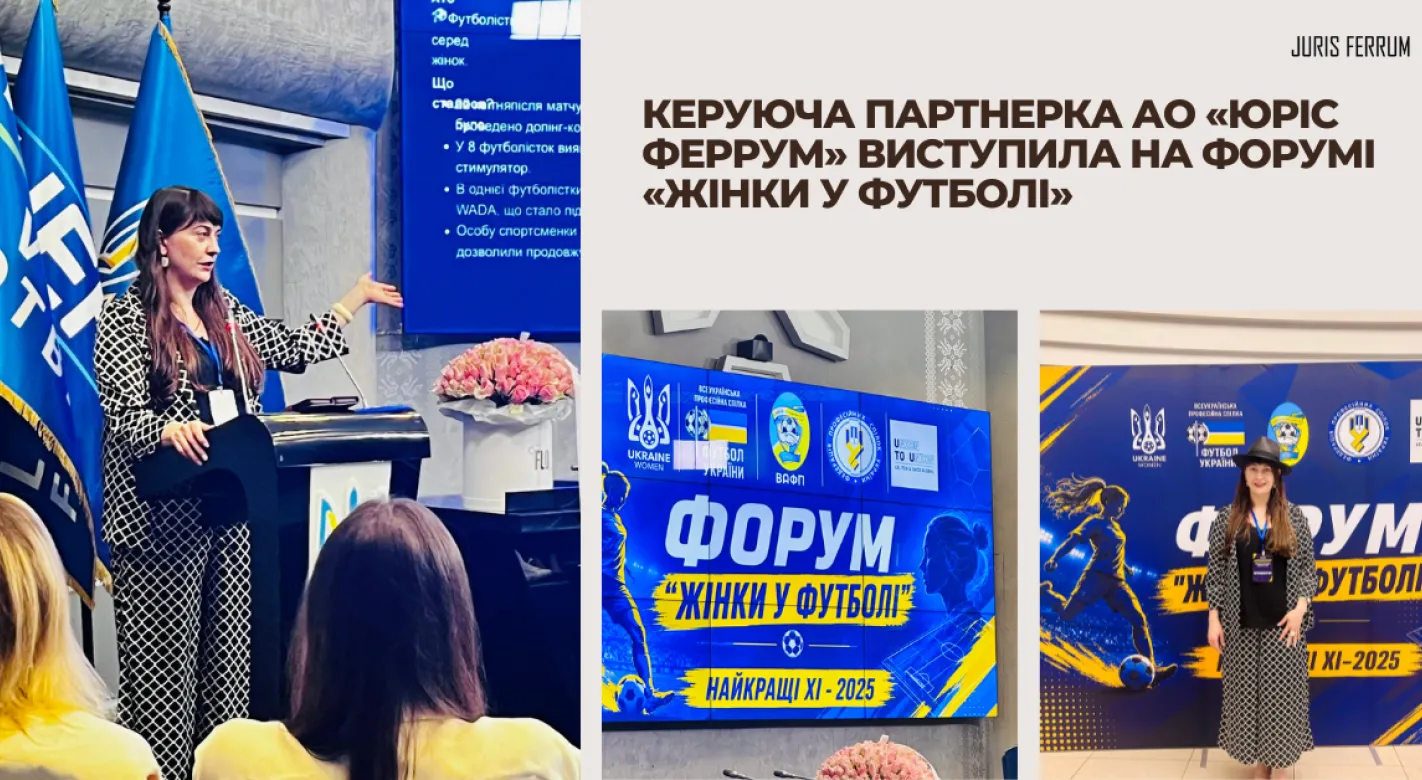
That is why anti-doping was among the topics addressed at the inaugural “Women in Football” Forum, held on July 30 at the UAF House of Football. The event brought together more than 100 participants — players, coaches, management representatives of women’s clubs from all leagues, as well as representatives of the UAF, Ukrainian Premier League (UPL), Professional Football League (PFL), Ministry of Youth and Sports of Ukraine, National Olympic Committee of Ukraine, NADC, and the Verkhovna Rada of Ukraine.
Among the Forum speakers was Ganna Gnizdovska, attorney, PhD in Law, Managing Partner of Juris Ferrum Law Firm, and Deputy Chair of the NADC Appeals Commission.
Her presentation was titled “Women’s Football and Doping: How the Rules of the Game Are Changing.”
Instead of focusing on abstract theory, participants learned about two notable international cases.
⚽ The case of Tottenham Hotspur Women player Chioma Ubogagu.
The athlete was prescribed medication by a dermatologist to treat acne, failed to check whether it complied with anti-doping rules, and did not declare it during doping control. Despite having no intention to gain a sporting advantage, the result was a nine-month period of ineligibility.
⚽ The case of a player from Norwegian club Vålerenga.
The investigation established that the source of the prohibited substance was rubber crumb from an artificial football pitch. The Norwegian anti-doping authority fully exonerated the athlete, and WADA did not appeal the decision.
These cases clearly demonstrate that anti-doping rules are not only about prohibited substances. They are also about due diligence, athlete education, and timely decisions that can help prevent a period of ineligibility before a problem even arises.
We thank the All-Ukrainian Trade Union “Football of Ukraine” for inviting us to participate in the “Women in Football” Forum. It is a great honor for us to be part of the professional dialogue on the development of women’s football and the shaping of its legal future. 🤝